
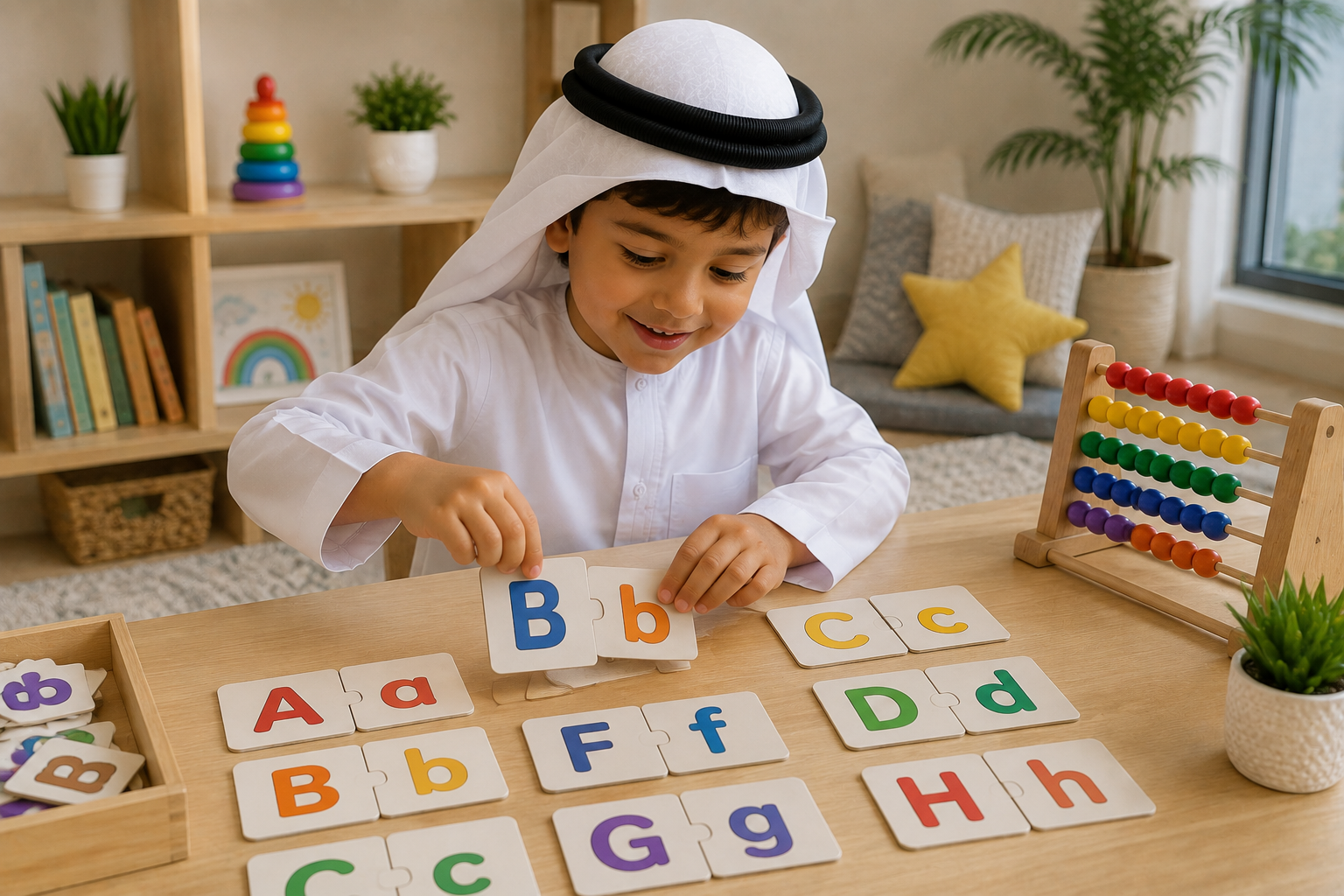
Learning that A and a are actually the same letter can feel obvious to an adult, but for a young child, it is an entirely new discovery. Some uppercase and lowercase letters look almost identical, while others look so different that children may initially think they are completely separate symbols. This is where uppercase and lowercase matching games can make alphabet practice much easier and more enjoyable.
Instead of asking children to memorise two versions of every letter, matching activities encourage them to look, compare, recognise, and connect the pairs through play. From simple card games and alphabet puzzles to letter matching games for kids online, these activities give young learners repeated practice without turning alphabet learning into a long lesson. For families exploring English learning games for kids in the UAE, letter matching can also be a practical starting point for building early English literacy skills at home.
Why Do Uppercase and Lowercase Letters Feel Different to Children?
Think about the alphabet from a child’s point of view.
Some pairs are quite straightforward:
C – c
O – o
S – s
V – v
The shapes remain relatively similar.
Then children encounter:
A – a
D – d
G – g
R – r
Suddenly things become more complicated.
A child may recognise a capital A perfectly but hesitate when shown lowercase a. They are not necessarily forgetting the alphabet. They are learning that one letter can appear in more than one visual form.
That connection takes time and repetition.
This is exactly why uppercase and lowercase matching games can be useful. Rather than simply telling children that A matches a, the activity asks them to discover and remember that relationship themselves.
What Are Uppercase and Lowercase Matching Games?
Uppercase and lowercase matching games are activities where children connect capital letters with their corresponding small letters.
A basic game might show:
A → a
B → b
C → c
D → d
The child needs to pair each uppercase letter with the correct lowercase version.
Online versions may ask children to tap, drag, select, or connect matching letters. Physical versions can use flashcards, magnetic letters, wooden alphabet pieces, sticky notes, or homemade paper cards.
The learning objective remains the same: helping children understand that uppercase and lowercase forms represent the same letter.
For beginners, the activity can start with just three or four pairs.
As confidence grows, parents can gradually introduce more letters until children are comfortable matching the entire alphabet.
Why Should Children Learn Both Uppercase and Lowercase Letters?
Children encounter both versions constantly.
Uppercase letters often appear:
- at the beginning of sentences;
- at the beginning of names;
- in headings;
- on signs;
- in labels;
- in alphabet charts.
Lowercase letters appear throughout most ordinary reading.
Open almost any children’s storybook and the majority of letters will be lowercase.
A child who only recognises uppercase letters may therefore know the alphabet but still struggle when looking at actual words.
Imagine a child knows:
C A T
But then sees:
cat
If lowercase recognition has not developed, the familiar word suddenly looks completely different.
Teaching both forms helps bridge the gap between learning individual letters and eventually reading words.
How Do Letter Matching Games Work?
The idea is beautifully simple.
The child receives one letter and searches for its matching form.
For example, they might see uppercase B and choose between:
d
b
p
To answer correctly, the child needs to carefully observe the shapes and remember which lowercase letter corresponds with B.
This makes letter matching games for kids more than simple entertainment.
Children are practising:
- visual recognition;
- memory;
- comparison;
- concentration;
- alphabet knowledge;
- decision-making.
As children repeat the activity, the connections gradually become more automatic.
Eventually, they no longer need to stop and think:
“Which lowercase letter matches M?”
They simply recognise m.
That growing automatic recognition can make later reading activities feel much easier.
Do Matching Games Help Kids Learn Faster?
They can certainly make practice more efficient and engaging, but “faster” should not become a race.
Every child learns at a different pace.
Some children recognise uppercase and lowercase pairs quickly. Others need repeated exposure over several weeks or months.
The real advantage of matching games is not that they magically teach the alphabet overnight. It is that they encourage children to practise the same skill repeatedly without the experience feeling overly repetitive.
A worksheet might ask a child to draw lines between matching letters.
That can be useful.
But an interactive game can present different pairs, change their positions, provide immediate responses, and invite the child to try again.
The repetition is still happening, but it feels more like a challenge.
That can encourage children to practise for longer and return to the activity more willingly.
Start With Familiar Letters
There is no need to introduce all 26 pairs at once.
Start with letters your child already knows.
A child’s own name is often perfect.
If your child’s name begins with S, start with:
S – s
If their sibling’s name begins with M:
M – m
If Dad begins with D:
D – d
Familiar letters already have meaning, which can make matching easier.
Once children confidently recognise those pairs, introduce additional letters gradually.
Parents exploring English learning games for kids in the UAE can use the same approach online: begin with simple alphabet activities and increase the challenge as recognition improves.
If you want to add more variety to home practice, you can explore EduPlayCraft’s interactive learning activities and choose a short alphabet-focused game that matches your child’s current ability rather than jumping straight to the hardest level.
Identical Letter Matching Comes First
Before asking children to connect uppercase and lowercase letters, it may help to begin with identical matching.
For example:
A → A
B → B
M → M
Then:
a → a
b → b
m → m
This teaches children the basic concept of matching.
Once they understand what the game expects, introduce mixed forms:
A → a
B → b
M → m
The learning challenge increases gradually rather than all at once.
This can be particularly useful for younger learners who are still becoming comfortable with alphabet shapes.
Make Similar-Looking Letters a Separate Challenge
Certain letters are commonly confused because they have similar shapes.
Lowercase:
b
d
p
q
can be particularly tricky for young learners.
Instead of becoming frustrated when your child mixes them up, turn the confusion into a game.
Place b and d beside each other.
Ask:
“Which one matches B?”
Let the child look carefully.
You can discuss simple visual differences rather than simply correcting them immediately.
The goal is observation.
With regular practice, children begin noticing characteristics that help distinguish one letter from another.
Turn Letter Matching Into a Memory Game
Memory games are an easy way to make matching more interesting.
Create pairs such as:
A – a
B – b
C – c
D – d
Place all the cards face down.
The child turns over two cards.
If they reveal A and a, they have found a pair.
If they reveal A and c, the cards are turned back over.
Now the child must remember both the letter and its location.
This combines alphabet recognition with memory and concentration.
Start with three or four letter pairs.
Adding all 26 immediately would be overwhelming for most young children.
As their memory and alphabet knowledge improve, add more cards.
Use a Letter Hunt Around the House
Letter matching does not have to happen at a desk.
Choose an uppercase letter and ask your child to search for its lowercase version around the house.
You might write uppercase letters on cards and hide lowercase cards in easy-to-find places.
Give your child:
T
Then ask:
“Can you find little t?”
The child searches until they discover the matching card.
You can reverse the activity too.
Give them lowercase m and ask them to find uppercase M.
A simple alphabet exercise suddenly becomes a treasure hunt.
Activities like this help children associate learning with movement and discovery rather than sitting still for long periods.
Match Letters With Children’s Names
Names are incredibly useful for alphabet learning because children naturally care about them.
Write your child’s name once in uppercase:
AMIRA
Then write it normally:
Amira
Ask your child to match the letters.
A → a
M → m
I → i
R → r
A → a
You can do the same with siblings, parents, friends, favourite characters, or even pets.
This gives letters a personal connection.
Instead of practising random symbols, children are learning letters that appear in words they already recognise.
Try Alphabet Sorting Games
Sorting gives children another way to think about uppercase and lowercase letters.
Create a mixture:
A
c
B
d
C
a
D
b
Ask the child to separate uppercase letters from lowercase letters.
Once they can do that confidently, ask them to create pairs.
A – a
B – b
C – c
D – d
The activity encourages children to notice both the differences and relationships between the two forms.
Sorting can be done with printed cards, magnetic letters, or uppercase and lowercase matching games online.
Using different formats keeps the underlying lesson familiar while changing the experience.
Match Letters With Pictures
Once children are comfortable recognising individual letters, add pictures.
Show:
B
Then provide pictures of:
ball
cat
sun
Ask which picture begins with B.
You can later repeat the activity with lowercase:
b
Children begin connecting uppercase B, lowercase b, and the sound associated with words such as “ball.”
This moves the activity beyond visual matching and begins connecting alphabet recognition with early language development.
That transition is important because the ultimate purpose of learning letters is not simply recognising symbols. It is understanding how those symbols work inside language.
Turn Everyday Reading Into Matching Practice
Books offer countless opportunities for informal matching.
While reading together, point to an uppercase letter at the beginning of a sentence.
Suppose the sentence starts with:
T
Ask:
“Can you find little t somewhere else on this page?”
Do not stop constantly to test every letter.
Story time should still feel like story time.
Instead, make one or two quick observations.
Over time, children begin noticing uppercase and lowercase versions themselves.
You may eventually hear:
“Look! Big A and little a!”
That spontaneous recognition is a strong sign that the connection is becoming familiar.
Use Online Games in Short Sessions
English learning games for kids UAE can provide useful practice, but more screen time does not automatically equal better learning.
Short, focused activities are usually easier for young children.
Rather than expecting your child to practise letters for an hour, try a short game lasting around 10–15 minutes and then move to something else.
You could follow the online activity with:
- drawing letters;
- reading together;
- finding letters around the house;
- using magnetic alphabet pieces;
- writing a child’s name;
- building letters with play dough.
This gives children multiple ways to encounter the same concept.
Online and offline learning can work together rather than competing with each other.
Let Children Drag and Match Letters
Drag-and-drop activities are particularly intuitive for children.
An online game might show uppercase letters on one side and lowercase versions on another.
The child drags:
A to a
G to g
T to t
This physical-style interaction encourages children to make the connection themselves.
When choosing letter matching games for kids, look for activities where children actively participate instead of simply watching letters appear on a screen.
They should need to think, choose, match, or arrange something.
Interaction is what turns an alphabet display into a learning activity.
Don’t Correct Every Mistake Immediately
Suppose your child matches:
B → d
Instead of instantly saying:
“No, that’s wrong.”
Try:
“Take another look. Which little letter looks like it belongs with B?”
Give them time.
They may notice the mistake independently.
That moment of self-correction can be more meaningful than being handed the answer.
If they still struggle, offer a clue.
“Let’s compare b and d.”
The goal is not to prevent mistakes.
Mistakes are part of learning.
What matters is helping children learn how to look again and try another approach.
Repeat Difficult Letter Pairs Naturally
Parents may notice certain pairs are harder than others.
Perhaps the child knows:
A – a
B – b
C – c
but repeatedly struggles with:
G – g
R – r
There is no need to restart the entire alphabet every time.
Focus on difficult pairs while continuing to include familiar ones.
For example, create a small game containing:
G – g
R – r
A – a
B – b
The familiar letters build confidence while the more difficult ones receive extra practice.
This targeted approach can make uppercase and lowercase matching games more effective than endlessly repeating every letter equally.
Encourage Children to Say the Letter
Matching does not need to remain purely visual.
When your child finds a pair, encourage them to say its name.
“A and a.”
“B and b.”
As they become more confident, you can also connect the letter to a familiar word.
“B, b, ball.”
“M, m, moon.”
This combines visual recognition with spoken language and vocabulary.
Keep it playful rather than turning every match into a test.
Make Letters With Everyday Materials
You do not need expensive learning resources.
Children can create letters using:
- crayons;
- pencils;
- play dough;
- craft sticks;
- building blocks;
- string;
- buttons;
- paper strips.
Ask your child to build uppercase L.
Then build lowercase l.
Try uppercase T and lowercase t.
This helps children pay close attention to shape.
Hands-on activities can be especially helpful when a child struggles to distinguish letters by looking at them on a screen alone.
Give Children Some Control
Young children often enjoy learning more when they get to make small choices.
Ask:
“Do you want to match letters or play a letter memory game?”
Or:
“Should we practise B, D and P today or M, N and R?”
Both choices still support learning.
But the child feels involved.
This can reduce resistance, especially when parents are trying to create a regular alphabet routine at home.
For another easy option, let your child browse a suitable EduPlayCraft alphabet activity with you and choose which game to try, while you keep the overall session focused on the letter pairs they currently need to practise.
Create a Simple Letter-Matching Routine
Home learning does not need a complicated schedule.
You could try:
Monday: Match identical uppercase letters
Tuesday: Match identical lowercase letters
Wednesday: Uppercase and lowercase matching
Thursday: Alphabet memory game
Friday: Letter hunt
Weekend: Read together and find matching letters in a book
Each activity can be brief.
Consistency is more useful than creating long sessions children begin to dislike.
And if your child particularly enjoys one activity, repeat it.
Learning routines should support curiosity, not remove it.
When Should Kids Start Letter Matching Activities?
There is no single perfect age because children develop at different rates.
Many children begin exploring letters during the preschool years.
Before formal matching, they may recognise the first letter of their name or identify a few familiar alphabet shapes.
Once a child can recognise several individual letters, simple matching activities can be introduced.
Start with obvious, familiar pairs.
Do not worry if your child cannot immediately match the entire alphabet.
Early literacy develops gradually.
Parents can look for readiness signs such as:
- showing interest in alphabet books;
- pointing out letters;
- recognising letters in their name;
- asking what written words say;
- enjoying alphabet songs;
- identifying a few familiar letters independently.
Follow the child’s curiosity.
Do Letter Matching Games Improve Alphabet Recognition?
They can provide valuable practice because children repeatedly need to identify and compare letters.
Recognition becomes stronger when children encounter letters in different contexts.
For example, a child might see lowercase a:
- in a matching game;
- inside a story;
- on a sign;
- in their name;
- on an alphabet card.
Repeated exposure helps make the shape familiar.
Letter matching games for kids also require children to actively retrieve information rather than only looking at an alphabet chart.
The child sees uppercase A and has to remember what lowercase form belongs with it.
That small act of thinking is the important part.
Can Matching Games Support Early Reading?
Yes, because recognising letters quickly is one of the early steps towards working comfortably with written words.
Imagine trying to read when every lowercase letter feels unfamiliar.
The child would need to stop constantly and identify each symbol.
As recognition becomes more automatic, children can focus more attention on sounds, word patterns, vocabulary, and meaning.
Letter matching is therefore one small piece of a much larger literacy journey.
It should be combined with:
- storytelling;
- reading aloud;
- conversations;
- songs;
- vocabulary activities;
- sound awareness;
- drawing and writing;
- playful word activities.
No single alphabet game needs to do everything.
Keep the Experience Positive
Children do not need to master uppercase and lowercase letters as quickly as possible.
They need opportunities to practise without becoming afraid of getting something wrong.
Celebrate progress.
If yesterday your child matched three pairs and today they matched five, that matters.
If they suddenly recognise lowercase g after struggling with it for several days, acknowledge the improvement.
You might say:
“You remembered that one today.”
Or:
“You looked carefully before choosing.”
This keeps attention on effort and improvement.
Combine Digital Games With Real-Life Learning
The strongest home learning routines usually involve more than one format.
Use English learning games for kids UAE for interactive practice, then bring the lesson into daily life.
After matching A and a online, find both versions in a book.
After practising M and m, look for words beginning with M around the house.
After working with B and b, ask the child to name something beginning with B.
The digital activity becomes a starting point rather than the entire lesson.
When children notice that the same letters appear everywhere, alphabet learning begins to make much more sense.
If your child is ready for regular letter practice, you can include an EduPlayCraft learning game alongside reading, drawing, matching cards, and everyday letter hunts to create a routine that remains varied and enjoyable.
So, Do Uppercase and Lowercase Matching Games Help Kids Learn Faster?
They can certainly help children practise more consistently and make alphabet recognition easier over time.
But the real benefit is not speed.
It is familiar.
Through uppercase and lowercase matching games, children repeatedly see that letters can have two forms while still representing the same letter. They learn to observe differences, remember relationships, and recognise letters in different settings.
And because the activity feels like a game, children may be more willing to keep practising.
The best approach is simple.
Start small.
Use familiar letters.
Keep sessions short.
Mix online and offline activities.
Let children make mistakes.
Repeat difficult pairs.
Read together.
Most importantly, keep alphabet learning enjoyable.
Eventually, matching A with a will no longer require any thought at all.
It will simply feel obvious.
And that small achievement becomes another important step towards confident reading and writing.
FAQs
1. How do uppercase and lowercase matching games work?
Uppercase and lowercase matching games ask children to connect capital letters with their corresponding lowercase forms, such as A with a, B with b, and C with c. Games may involve cards, puzzles, drag-and-drop activities, memory challenges, or letter hunts. Repeated matching helps children become familiar with the different ways each letter can appear.
2. Why should children learn uppercase and lowercase letters?
Children encounter both uppercase and lowercase letters when reading and writing. Uppercase letters appear at the beginning of sentences, in names, headings, and signs, while most text in books is written largely in lowercase. Recognising both forms helps children become more comfortable with written language and prepares them for early reading.
3. At what age can kids start letter matching activities?
Children can begin simple letter matching during the preschool years when they show interest in letters and can recognise a few familiar alphabet shapes. There is no fixed age for every child. Parents should start with a small number of familiar letters and gradually introduce additional pairs as confidence develops.
4. Do letter matching games improve alphabet recognition?
Yes, letter matching games for kids can support alphabet recognition by giving children repeated opportunities to identify, compare, and connect different letter forms. Practising the same letters through games, books, cards, and everyday activities can gradually make recognition more automatic.
5. How can I help my child practise letter matching at home?
Parents can use homemade cards, magnetic letters, alphabet books, sticky-note treasure hunts, memory games, sorting activities, and suitable English learning games for kids in the UAE. Keep sessions short, begin with familiar letters, mix uppercase and lowercase forms, and connect the activity with words and objects your child already knows. A combination of online games and hands-on practice can keep letter learning varied and enjoyable.