

There is something surprisingly exciting about the moment a child begins recognising letters. At first, the alphabet may look like a collection of random shapes, but soon your child starts spotting familiar letters on books, toys, shop signs, cereal boxes, and even in their own name. That growing curiosity is an important part of early learning, but keeping it enjoyable matters. Repeating A to Z again and again can quickly feel boring, while matching activities, picture challenges, letter hunts, and alphabet games for kids can make the same learning experience feel much more playful.
Well-designed games help children recognise letter shapes, connect uppercase and lowercase letters, and understand individual letters instead of simply memorising the alphabet in order. With ABC learning games online, parents can introduce short and engaging practice sessions at home without making learning feel like another classroom lesson. The goal is to help children become comfortable and confident with letters while keeping alphabet practice interesting enough that they genuinely want to continue.
Why Learning the Alphabet Is Such an Important Early Skill
Before children can confidently read words, they need to understand that written language is made up of letters.
Alphabet knowledge helps create that foundation.
A child gradually learns that:
- letters have different shapes;
- every letter has a name;
- uppercase and lowercase versions may look different;
- letters appear inside words;
- different words begin with different letters;
- letters can be arranged together to form meaningful words.
This does not all happen at once.
For young learners, alphabet development is usually a gradual process built through repeated exposure.
A child might first recognise the letter in their own name.
Then they may notice the first letter of “Mum” or “Dad.”
Later, they begin identifying more letters independently.
Good letter recognition games for kids support this process by giving children repeated opportunities to see and work with letters without making every activity feel identical.
Why Alphabet Games Work So Well for Young Children
Children love doing things.
They want to tap, move, select, match, arrange, find, and discover.
Alphabet games take advantage of that natural desire to interact.
Instead of simply showing a child the letter B and saying, “This is B,” a game might ask:
“Can you find B?”
“Which lowercase letter matches B?”
“Which picture begins with B?”
“Can you place B in the correct position?”
Now the child needs to make a decision.
That small change turns passive learning into active learning.
When children actively identify letters themselves, they get more opportunities to practise observation and recall.
The experience becomes:
Look.
Think.
Choose.
Check.
Try again.
That cycle is one reason alphabet games for kids can be more engaging than endless repetition with flashcards alone.
Flashcards can still be useful, of course. The point is not to replace traditional activities but to add variety.
Start With Simple Letter Recognition Games
One of the best places to begin is simple recognition.
Show a few letters and ask the child to identify one.
For example:
“Where is A?”
Your child chooses between A, M, and T.
That sounds incredibly basic to an adult, but for a young learner it requires visual recognition.
As confidence improves, increase the number of choices.
You can also vary the way letters appear.
Sometimes show them individually.
Sometimes place them among other letters.
Sometimes use them inside simple words.
The goal is helping children recognise a letter even when its surroundings change.
This is where letter recognition games for kids become especially valuable. They can provide many small recognition challenges without making parents prepare a new worksheet each time.
Alphabet Matching Games
Matching is one of the easiest ways to turn letter learning into play.
Start by matching identical letters:
A → A
B → B
C → C
Then gradually move towards matching uppercase and lowercase letters:
A → a
B → b
C → c
This step is important because uppercase and lowercase letters do not always look very similar.
Think about:
A and a
G and g
R and r
A child who confidently recognises uppercase A may still need practice understanding that lowercase a represents the same letter.
Good ABC learning games online can present both forms repeatedly so children begin connecting them naturally.
You can continue the activity away from the screen too.
Write uppercase letters on small pieces of paper and lowercase versions on another set.
Scatter them across the table and ask your child to find the pairs.
Suddenly alphabet practice becomes a small treasure hunt.
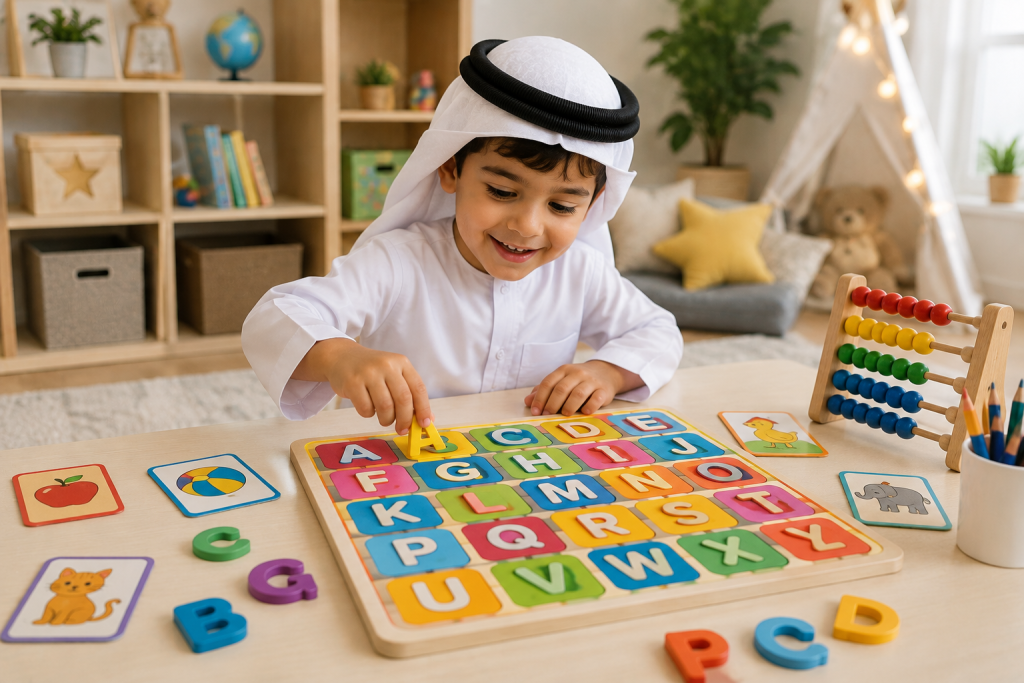
Picture and Letter Matching Games
Pictures make letters easier to understand because children can connect an abstract symbol with something familiar.
For example:
A – Apple
B – Ball
C – Cat
D – Dog
Instead of memorising C as a shape, the child begins associating it with a familiar word.
A picture-matching alphabet game might show a cat and ask which letter its name begins with.
The child sees three choices:
C
M
T
They choose C.
That activity combines letter recognition with vocabulary and early sound awareness.
As children become more confident, parents can extend the game into everyday conversations.
Ask:
“What else begins with C?”
Maybe the child says “car.”
Then ask:
“Can you find something in this room that begins with B?”
You have now taken an online activity and turned it into real-world learning.
If your child enjoys this style of playful practice, exploring alphabet-focused activities on EduPlayCraft can give you another easy way to introduce letters through interactive challenges rather than repetitive drills.
Alphabet Order Games
Learning the alphabet in sequence is another useful skill.
Many children begin by memorising the alphabet song, which helps them remember the order of letters.
But being able to sing A to Z does not necessarily mean a child recognises every letter individually.
That is why alphabet-order games can help.
A game might show:
A, B, __, D
The child has to identify C.
Later, the challenge might become:
H, I, __, K
Or letters may be scattered and need to be arranged in the correct order.
This helps children move beyond memorising a song and begin understanding how letters are organised.
However, parents should avoid focusing only on alphabetical order.
A child should also be able to recognise letters when they appear randomly.
If your child can sing the entire alphabet but struggles when you point to M individually, spend more time on recognition games.
Uppercase and Lowercase Letter Games
Uppercase and lowercase matching deserves extra attention because it is a major step in early literacy.
Children often encounter uppercase letters first because their shapes can be easier to distinguish.
Later, they discover lowercase letters in books and everyday writing.
Suddenly things become more complicated.
The letter “A” now appears as “a.”
“D” becomes “d.”
“G” may look quite different as “g.”
This is where letter recognition games for kids that include uppercase and lowercase forms can be particularly helpful.
A game might present several lowercase letters and ask:
“Which letter matches uppercase T?”
The child selects t.
You can also create simple home activities.
Write uppercase letters on sticky notes and place lowercase versions around the room.
Ask your child to find the matching pairs.
For example:
Find A and bring it to a.
Find R and bring it to r.
Learning becomes physical, playful, and memorable.
Letter Sorting Games
Sorting activities are another simple way to practise recognition.
Give children several letters and ask them to sort them according to different rules.
For example:
Uppercase letters on one side.
Lowercase letters on the other.
Or:
Letters in their name in one group.
Other letters in another.
Older or more confident children might sort letters according to whether they appear at the beginning of certain words.
The activity encourages careful observation rather than quick guessing.
Digital versions of sorting activities can provide immediate feedback, while physical versions using cards, magnetic letters, or paper make a useful offline alternative.
Combining both approaches gives children variety.
Letter Hunt Games
One of the easiest alphabet activities requires no special materials at all.
Choose a letter.
Then hunt for it.
Suppose today’s letter is S.
Ask your child to find S:
- inside a storybook;
- on a food packet;
- on a toy box;
- on a sign;
- on a keyboard;
- in a magazine.
Children often enjoy this because it feels more like searching for hidden objects than studying.
You can also turn it into a word hunt.
“Can you find something that starts with S?”
Spoon.
Sock.
Soap.
This helps children understand that letters are not just shapes displayed in alphabet charts. They are everywhere in everyday communication.
Memory Games With Letters
Memory games can combine alphabet practice with concentration.
Create pairs of letter cards.
Place them face down.
Let your child turn over two at a time.
If the letters match, they keep the pair.
If not, turn them back over.
For beginners, use identical pairs:
A – A
B – B
For more advanced learners, create uppercase-lowercase pairs:
A – a
B – b
Now the child has to remember both location and letter relationships.
That makes the activity more challenging while still keeping it playful.
Online memory-style alphabet games for kids can offer the same type of practice, particularly for children who enjoy visual challenges.
Missing Letter Games
Once children have developed basic recognition, missing-letter games introduce an extra layer of thinking.
Start with alphabet sequences:
A, B, __, D
Then progress to simple words:
C _ T
Ask:
“Which letter is missing?”
If the child knows the picture represents a cat, they can use both visual information and letter knowledge.
This begins moving alphabet recognition toward early word building.
Keep the words familiar.
Young children are more likely to succeed with words such as:
cat
dog
sun
hat
car
ball
The goal is not to create a spelling test.
It is to help children notice how letters come together.
Make Alphabet Learning Personal
Children often become interested in letters through their own names.
That makes a child’s name one of the best starting points for alphabet learning.
Write their name clearly.
Ask:
“What letter does your name start with?”
Then look for that letter elsewhere.
If your child’s name starts with A, find A in books, signs, packaging, and games.
You can also explore the letters in family members’ names.
“Dad starts with D.”
“Mum has M.”
“Your sister’s name starts with S.”
Personal connections make letters more meaningful.
Instead of learning random symbols, children begin understanding that letters belong to words that matter to them.
Don’t Introduce Too Many Letters at Once
Parents can easily become excited and try to teach A to Z as quickly as possible.
There is no need to rush.
Children learn differently.
Some may quickly recognise several letters.
Others need more repetition.
Focus on a small group at first.
Perhaps start with letters found in your child’s name.
Then introduce familiar letters from common words.
Once the child confidently recognises them, add more.
This approach can make ABC learning games online more effective too. If a game offers difficulty levels or progressive activities, choose the level that matches your child’s current ability rather than automatically selecting the most advanced option for their age.
Use Short Alphabet Sessions
A 10- or 15-minute focused session can be far more useful than an hour of distracted practice.
Young children have limited attention spans, and alphabet learning should not become exhausting.
You might play one letter game after breakfast.
Do a letter hunt later.
Read a book before bedtime and point out one or two familiar letters.
That is plenty.
Regular short exposure is usually easier to maintain than occasional long lessons.
And importantly, it keeps learning from feeling like punishment.
Let Your Child Choose Sometimes
Children often engage more when they feel involved.
Instead of saying:
“You are doing the alphabet game now.”
Try:
“Do you want to play the letter-matching game or the ABC picture game?”
You still control the learning options, but the child gets a choice.
That sense of independence can make practice feel much more enjoyable.
EduPlayCraft can fit naturally into this type of routine by giving parents a place to choose an age-appropriate alphabet or early-learning activity and then allowing children to practise through a game rather than another worksheet.
Combine Online and Offline Alphabet Practice
Digital learning works best when it does not stay entirely on the screen.
After your child finishes an alphabet game, continue the concept elsewhere.
If they practised B, ask them to find:
a ball
a book
a bag
If they practised M, look for:
milk
mug
mat
If they worked on uppercase and lowercase letters, write both versions with crayons.
If they played a matching game, create physical matching cards.
The online game introduces or reinforces the idea.
Real-world practice makes it more meaningful.
This combination is especially useful because children encounter the same concept in different ways.
Read Together Regularly
Books provide one of the best environments for alphabet recognition.
You do not need to stop on every page and test your child.
That can make story time frustrating.
Instead, casually point to familiar letters occasionally.
“Look, there’s another B.”
“Can you see the first letter in ‘dog’?”
“What letter does this word start with?”
Keep the focus on enjoying the story.
Alphabet learning should support reading, not interrupt it.
Over time, children begin noticing familiar letters without being prompted.
That is a wonderful sign of growing recognition.
Praise Effort, Not Just Correct Answers
Children will make mistakes.
That is normal.
If your child confuses b and d, or forgets whether a particular shape is P or R, there is no reason to turn it into a big problem.
Instead say:
“Look closely and try again.”
Or:
“You remembered that one after another look.”
This encourages persistence.
A good learning environment makes children comfortable trying answers even when they are unsure.
The purpose of letter recognition games for kids is practice, not perfection.
Keep Alphabet Games at the Right Difficulty
An activity that is too easy quickly becomes boring.
One that is far too difficult becomes frustrating.
Watch how your child responds.
If every answer is immediate, introduce a slightly harder challenge.
Maybe move from identical-letter matching to uppercase-lowercase matching.
If your child is guessing randomly and becoming upset, simplify the activity.
Maybe return to two or three familiar letters before introducing new ones.
The best learning happens when a child needs to think but still has a reasonable chance of success.
Turn Mistakes Into Part of the Game
Games naturally create opportunities to try again.
That is valuable.
A worksheet filled with red marks can make mistakes feel negative.
In a game, choosing the wrong answer often simply means:
“Try again.”
Children learn that an incorrect answer is not the end of the activity.
They look again.
Compare the letters.
Think differently.
Choose another answer.
This helps build persistence alongside alphabet knowledge.
Build a Simple Alphabet Routine at Home
Parents do not need a complicated curriculum.
A simple weekly routine could look like this:
Monday: Letter recognition game
Tuesday: Alphabet picture matching
Wednesday: Uppercase and lowercase matching
Thursday: Letter hunt around the house
Friday: Missing-letter or alphabet-order game
Weekend: Read together and look for familiar letters
The routine can change whenever needed.
If your child loves one particular activity, repeat it.
If they are struggling with certain letters, spend more time there.
Flexibility is one of the advantages of home practice.
You can also explore EduPlayCraft’s learning activities and select a game that matches the letter skill your child is currently practising, keeping the session short and enjoyable rather than treating it like formal homework.
Alphabet Learning Should Feel Like Discovery
There is no prize for teaching the alphabet faster than everyone else.
What matters is helping children become familiar and confident with letters.
When alphabet practice feels playful, children are more likely to remain curious.
They begin noticing letters independently.
They point them out in books.
They recognise them on signs.
They try writing them.
They connect them with words.
Eventually, those individual letters begin forming something much bigger: reading and writing.
That is why alphabet games for kids can be such a helpful starting point.
They transform letters from abstract shapes into things children can find, match, arrange, remember, and explore.
Whether you use physical letter cards, magnetic letters, storybooks, household objects, or ABC learning games online, variety is the key.
Keep the sessions manageable.
Follow your child’s pace.
Celebrate small improvements.
And most importantly, allow alphabet learning to remain enjoyable.
Because when children enjoy discovering letters, they are much more likely to keep looking for them everywhere.
FAQs
1. What are the best alphabet games for young children?
The best alphabet games for kids are simple, age-appropriate activities that encourage children to recognise and interact with letters. Good options include letter matching, picture-to-letter games, alphabet-order challenges, missing-letter activities, letter hunts, memory games, and uppercase-lowercase matching. Online games can also provide interactive practice when combined with books and hands-on activities at home.
2. At what age should children start learning the alphabet?
Children can begin becoming familiar with letters during the preschool years, although there is no single age at which every child must know the entire alphabet. Early learning can begin naturally through songs, books, names, pictures, and simple games. Parents should follow the child’s interest and introduce letters gradually rather than expecting immediate memorisation.
3. How do alphabet games improve letter recognition?
Alphabet games give children repeated opportunities to see, identify, compare, and select letters. This repetition helps them become more familiar with letter shapes. Letter recognition games for kids can also present letters in different contexts, helping children recognise them outside a fixed alphabet chart or song.
4. Can ABC games help children learn uppercase and lowercase letters?
Yes. ABC learning games online can help children practise matching uppercase letters with their lowercase versions, such as A with a or B with b. This is useful because some uppercase and lowercase letters look noticeably different. Matching games, sorting activities, and memory challenges can make these relationships easier to practise.
5. How can parents make alphabet practice fun at home?
Parents can make alphabet practice fun by using short games rather than long lessons. Try letter hunts around the house, alphabet matching cards, magnetic letters, picture games, storybook searches, missing-letter challenges, and age-appropriate online activities. Giving children choices, connecting letters with their names and familiar objects, and praising effort can also help keep alphabet learning enjoyable.