
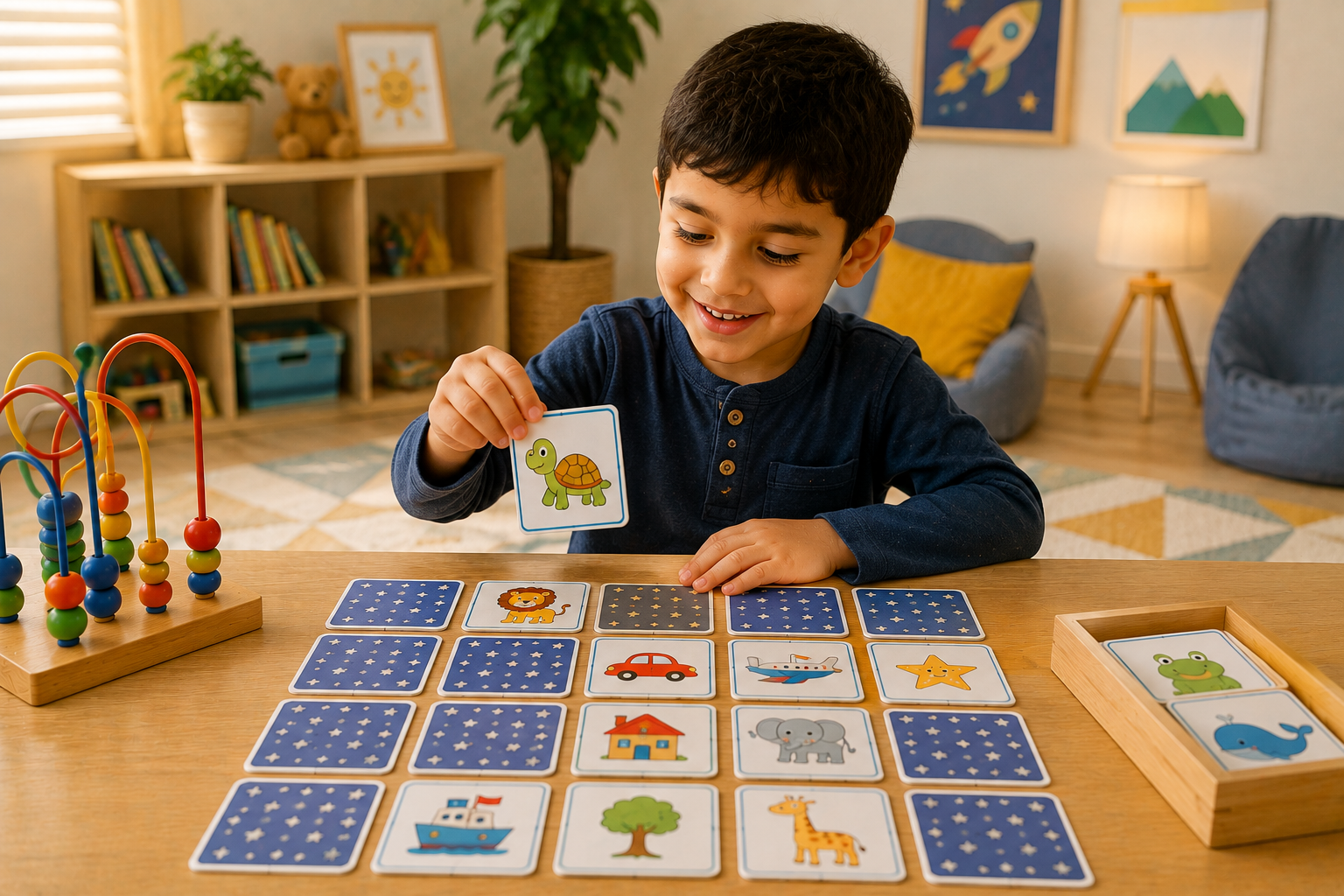
A child turns over one card, studies the picture, turns over another and realises it does not match. A few moments later, that first picture appears again and suddenly they remember exactly where its partner is hiding. To an adult, it may look like a simple game. For a young child, however, quite a lot of thinking is happening at once.
That is what makes matching games for kids so useful in early learning. Children need to observe carefully, remember information, compare choices and stay focused long enough to find the correct answer. Whether they are matching pictures, colours, numbers, letters, shapes or related objects, these seemingly simple activities can support several important learning skills while still feeling like play.
Why Are Matching Games So Popular With Young Children?
Matching games have one major advantage: children usually understand the idea very quickly.
Find two things that belong together.
That simple goal can be adapted in dozens of ways. Younger children might match two identical animals, while older children could match uppercase letters with lowercase letters, numbers with quantities or objects with their correct categories.
Because the basic activity is easy to understand, children can concentrate on solving the challenge instead of trying to remember complicated instructions.
This is one reason memory games for children often use a matching format. The rules remain simple while the thinking challenge can gradually become more difficult.
Matching Games Encourage Careful Observation
Before children can match two objects, they need to notice what makes them similar.
Imagine a game showing several pictures of animals. The child is looking for two identical elephants.
They may need to notice the animal’s shape, colour, size or position.
Now imagine a more advanced activity where they need to match an animal with its shadow. The pictures are no longer identical, so the child has to think about characteristics rather than simply spotting the same image twice.
Observation becomes increasingly important.
The same skill applies to letters.
A child matching:
B with b
needs to understand that the two symbols look different but represent the same letter.
Matching activities therefore encourage children to look beyond the most obvious features and think about relationships.
How Matching Games Support Memory
Memory becomes especially important when cards or objects are hidden.
In a traditional memory matching game, several cards are placed face down.
A child turns over two.
Perhaps they discover a star and an apple.
Those cards do not match, so they are turned over again.
Later, the child sees another apple.
Now they need to remember:
“Where did I see the first apple?”
That requires active recall.
The child is not simply recognising something that is directly visible. They are retrieving information from an earlier turn.
This repeated remembering is one reason memory games for children can be such an enjoyable way to practise short-term visual memory.
As children improve, parents can gradually increase the number of cards and make the challenge more demanding.
Matching Games Can Help Children Practise Focus
To succeed in a matching game, children need to pay attention.
If they look away every time a card is revealed, remembering its position becomes difficult.
That naturally encourages concentration.
Children begin watching carefully because the information matters to the next move.
This is different from simply telling a child:
“Pay attention.”
The game gives them a reason to focus.
They want to find the pair.
They want to remember where the picture appeared.
They want to complete the challenge.
This purposeful concentration can make matching games for kids especially useful for short learning sessions at home.
Focus Develops Gradually
Parents should not expect young children to concentrate for long periods immediately.
Attention develops over time.
A matching game with four cards may be enough for a beginner.
Once that feels easy, introduce six.
Then eight.
The challenge grows alongside the child’s ability.
If the activity is too difficult, the child may start guessing randomly.
If it is too easy, they may lose interest.
The best level requires some thought while still giving the child a realistic chance of success.
Matching Games Can Introduce Problem-Solving
Matching is not always about finding identical pictures.
Some activities require children to figure out a relationship.
For example:
toothbrush → toothpaste
shoe → sock
bird → nest
fish → water
Now children are not simply comparing appearances. They need to think about how two things are connected.
These activities start becoming problem solving games for kids because children must use what they know to make a decision.
A child might ask themselves:
“What belongs with this?”
“Where would this animal live?”
“Which object is used with this one?”
That reasoning adds another layer to the game.
Picture Matching Games for Younger Children
Simple picture matching is a good starting point.
Show a child several images and ask them to find two that are exactly the same.
Perhaps there are:
two cats, two balls and two cars.
The child pairs the identical images.
This introduces the basic concept without adding too much difficulty.
Once children understand the rules, parents can make the activity more challenging by using pictures that look similar but are not identical.
Maybe one cat is sitting while another is standing.
Now careful observation matters even more.
If your child enjoys visual challenges like these, exploring a suitable matching activity on EduPlayCraft can add another playful option to home learning while keeping the session short and manageable.
Colour Matching Games
Colours provide another easy introduction.
Give children coloured cards or objects and ask them to match:
red with red;
blue with blue;
yellow with yellow.
Later, ask them to match colours with real objects.
For example:
yellow → banana
green → leaf
This combines colour recognition with vocabulary and observation.
Parents can continue the game anywhere.
“Can you find something red in this room?”
“Which toy matches the colour of this card?”
The learning moves beyond the game itself.
Shape Matching Games
Shape activities can help children notice visual characteristics.
A basic challenge might involve matching:
circle → circle
square → square
triangle → triangle
More advanced activities could ask children to match a shape with an object that contains the same form.
For example:
circle → clock
rectangle → door
triangle → road sign
Now children need to recognise the underlying shape even when it appears as part of something else.
This encourages flexible thinking.
Letter Matching Games
Alphabet learning provides many opportunities for matching.
Beginners might match identical letters:
A → A
B → B
C → C
Later, the challenge can become:
A → a
B → b
C → c
Children begin understanding that uppercase and lowercase versions belong together.
Letter matching can also include pictures.
For example:
B → ball
C → cat
D → dog
The activity now combines alphabet recognition with vocabulary.
This is one reason matching formats work well across different subjects. The rules stay familiar even when the learning goal changes.
Number Matching Games
Maths can also become part of matching play.
A child might match:
3 → three dots
5 → five stars
7 → seven blocks
They need to recognise the numeral, count the objects and connect the two.
Another activity might involve matching identical numerals or placing number cards in pairs.
These games can help children understand that written numbers represent real quantities.
Matching Opposites
Once children understand basic matching, opposites can create a more thoughtful challenge.
Examples might include:
big → small
hot → cold
up → down
day → night
The pictures no longer look alike.
The child needs to understand the concept connecting them.
These types of activities are closer to problem solving games for kids because children need to think about meaning rather than visual similarity alone.
Matching Objects That Belong Together
Another useful variation involves related objects.
Show pictures such as:
lock and key;
cup and saucer;
pencil and paper;
shoe and sock.
Ask the child to find what belongs together.
Parents can turn this into a real household activity too.
Place several safe objects on a table and ask children to make pairs.
The important question becomes:
“Why do these belong together?”
Encouraging children to explain their choice can turn a quick matching activity into a richer conversation.
Matching Animals With Their Homes
Children who enjoy animals may love this version.
Ask them to match:
bird → nest
bee → hive
fish → water
dog → kennel
The activity introduces vocabulary and general knowledge while still using a familiar game structure.
If the child makes an unexpected match, ask:
“Why did you choose that?”
Their answer may reveal interesting reasoning.
Sometimes children understand the concept differently from what adults expect.
Matching Animals With Their Babies
Another playful variation is connecting adult animals with their young.
Children might match a dog with a puppy or a cat with a kitten.
This expands vocabulary while strengthening the ability to recognise relationships.
The same concept can be adapted to food, transport, clothing, household objects and many other themes.
Matching does not have to become repetitive because the subject can change while the fundamental thinking skill remains the same.
How Memory Matching Games Become More Challenging
A memory game can grow with the child.
Begin with only a few visible or hidden pairs.
Once children remember them easily, add more.
You can also change the type of pair.
Instead of:
apple → apple
try:
apple → A
Or:
4 → four objects
Now children need to remember the location while also understanding the relationship between the cards.
This combination makes memory games for children increasingly useful for both cognitive practice and subject learning.
Why Immediate Answers Are Not Always Best
Parents naturally want to help when a child gets stuck.
But giving the answer immediately can remove part of the thinking opportunity.
Suppose your child cannot remember where the matching card is.
Instead of pointing to it, ask:
“Where did you see that picture before?”
Or:
“Which cards have you already checked?”
Give them a moment.
Even if the answer is eventually incorrect, the child has practised recalling information and considering possibilities.
That thinking process matters.
Matching Games Teach Children to Try Again
Mistakes are normal in matching activities.
A child chooses two cards.
They do not match.
The cards are turned back over.
Nothing terrible happens.
They simply try again.
That simple cycle teaches persistence.
Instead of seeing an incorrect choice as failure, children begin seeing it as information.
“Okay, the car isn’t there. Now I know something I didn’t know before.”
This is an early form of problem-solving.
Every unsuccessful attempt can provide another clue.
Matching Games and Visual Discrimination
Visual discrimination means noticing differences and similarities between visual information.
This skill becomes important when children begin working with letters and numbers.
Consider:
b and d
6 and 9
p and q
These symbols can look surprisingly similar to young learners.
Matching and sorting games encourage children to look more carefully at direction, shape and detail.
A child who regularly practises comparing visual information may become more comfortable noticing small differences.
Can Matching Games Improve Concentration?
Matching games can certainly encourage children to practise concentrating because paying attention improves their chances of succeeding.
Imagine a memory game with ten hidden cards.
If the child remembers where each picture appears, they can find the pairs faster.
That creates a natural incentive to watch.
The concentration is not being demanded by an adult.
It is being encouraged by the game.
That distinction can make the activity more enjoyable.
However, concentration should still be developed gradually. Young children are not expected to stay focused for extremely long periods.
Short, engaging sessions are usually more suitable.
Matching Games Do Not Need to Be Digital
Online activities are convenient, but many excellent matching games can be created using things already available at home.
You can use cards, toys, socks, blocks, pictures, stickers, bottle caps or magnetic letters.
Laundry can even become a matching activity.
“Can you find the two socks that belong together?”
Children compare colours, patterns and sizes while helping with an everyday task.
That is learning through play in one of its simplest forms.
Digital Matching Games Can Add Variety
Interactive online games can be useful because they can quickly present different pictures and challenges.
Children may tap matching objects, drag pairs together or uncover digital cards.
A good digital matching activity should encourage children to make decisions rather than simply watch animations.
Parents can occasionally sit alongside the child and ask:
“How did you know those matched?”
“What do you remember seeing earlier?”
“Which one do you think belongs here?”
This turns screen time into a conversation as well as an activity.
When you want to add a new matching challenge to the routine, browsing EduPlayCraft together and letting your child choose an age-appropriate game can make them feel more involved in the learning process.
Keep Matching Sessions Short
More time does not automatically create better learning.
A child who concentrates carefully for ten minutes may get more from the activity than one who plays absent-mindedly for forty minutes.
Watch your child’s behaviour.
If they are:
looking carefully;
remembering previous turns;
thinking before selecting;
enjoying the challenge;
the game is probably at a useful level.
If they begin clicking randomly or becoming frustrated, it may be time to stop or simplify the activity.
Use Matching Games as Part of a Balanced Routine
Educational games work best alongside many other types of play.
Children also benefit from books, building, drawing, pretend play, outdoor activity, conversation and physical movement.
Matching games can simply become one part of that larger mix.
You might play a digital matching activity one day and use physical cards the next.
Another day, match socks while folding laundry.
Later, pair animals with pictures in a book.
Variety helps children use the same thinking skills in different situations.
How Often Should Children Play Matching Games?
There is no need for a strict daily requirement.
Short matching activities can be included several times during the week if the child enjoys them.
What matters more is quality than frequency.
Five or ten minutes of thoughtful matching can be useful.
An hour of distracted clicking is unlikely to offer the same value.
Parents should also follow the child’s interest.
If they repeatedly ask to play a favourite memory game, there is nothing wrong with repeating it.
As it becomes too easy, gradually make the challenge more complex.
Follow the Child’s Ability, Not Just Their Age
Age recommendations can be helpful, but children develop differently.
One four-year-old may comfortably match ten hidden pairs.
Another may prefer three visible pairs.
Neither situation automatically indicates a problem.
Start with what the child can manage.
Then increase difficulty gradually.
Look for signs that the activity is appropriately challenging.
The child should need to think, but they should still experience success.
That balance keeps motivation alive.
Make Matching Games Personal
Children often respond well when games feature subjects they love.
If your child enjoys animals, use animal matching.
If they love vehicles, match cars, buses and trains.
If they enjoy letters, create alphabet pairs.
If they are interested in numbers, match quantities.
A personalized theme does not change the underlying skill.
The child is still observing, remembering and solving problems.
It simply makes the activity more appealing.
Ask Children to Explain Their Matches
One of the easiest ways to deepen a matching activity is to ask:
“Why do these go together?”
Suppose a child matches:
umbrella → rain
They might say:
“You use the umbrella when it rains.”
Now they are explaining a relationship.
This encourages language development and reasoning in addition to matching.
The same question works with many types of problem solving games for kids.
Rather than focusing only on whether the answer is correct, parents can become curious about how the child reached it.
Create Your Own Matching Cards
Homemade matching games can be extremely simple.
Draw or print pairs of familiar objects.
Start with four pairs.
Let the child look at them.
Turn them face down.
Take turns finding matches.
As children become more confident, add more cards.
You can even involve your child in making them.
Ask them to draw two suns, two houses or two flowers.
Now creating the game becomes part of the learning experience.
Try a Sound Matching Game
Matching does not always need to be visual.
Parents can also play with sounds.
Make pairs of containers containing similar materials.
For example, two may contain rice and another two may contain small beads.
Shake them and ask the child which sounds match.
This introduces careful listening.
It also shows children that matching means identifying similarities across different kinds of information, not only pictures.
Match Objects by Category
Give children several objects or pictures.
Ask them to find which ones belong together.
For example:
apple, banana and orange belong together as fruit.
Car, bus and bicycle belong together as transport.
Shirt, trousers and socks belong together as clothing.
Categorisation requires children to notice a shared characteristic.
That makes it another useful form of problem-solving.
Try Pattern Matching
Patterns provide an extra challenge.
Show:
red, blue, red, blue
Ask:
“What should come next?”
Or create a sequence:
circle, square, circle, square.
Children need to identify the rule rather than find an identical picture.
This expands matching into early logical reasoning.
It can also prepare children for more advanced pattern work in maths.
Celebrate Careful Thinking
Praise does not have to focus only on getting pairs correct.
Try saying:
“You remembered where that card was.”
“You looked really carefully.”
“You tried another idea.”
“You noticed those two were different.”
These comments draw attention to the skills being used.
Children begin understanding that concentration, observation and persistence help them solve problems.
Don’t Turn Every Match Into a Test
Matching games should remain playful.
Parents do not need to ask:
“How many did you get right?”
after every session.
Sometimes it is enough to enjoy the activity together.
If learning becomes overly focused on performance, children may start worrying about mistakes instead of exploring.
The aim is to create opportunities for practice, not constant assessment.
Move From Simple Matching to Reasoning
Matching games can grow surprisingly far with a child.
A young learner might begin with:
cat → cat
Later:
C → c
Then:
C → cat
Later still:
cat → animal
Eventually:
animal → habitat
The basic idea of finding relationships remains, but the thinking becomes increasingly sophisticated.
That makes matching an adaptable activity for different stages of early learning.
Combining Memory, Focus and Problem-Solving
The most interesting matching games often involve several skills at once.
Imagine a hidden-card activity where children need to match numbers with corresponding quantities.
To succeed, they must remember where cards appeared, recognise numerals, count objects, compare information and stay focused across several turns.
That is a lot of learning inside one simple game.
This explains why matching games for kids can be much more valuable than they first appear.
Children are not simply finding pairs.
They are learning how to observe information, remember it and use it to make decisions.
If matching activities have become a favourite at home, adding an EduPlayCraft game alongside physical card games, puzzles and everyday sorting activities can keep the experience varied while allowing children to practise the same core skills in different ways.
Making Learning Feel Like a Challenge Worth Solving
The best educational activities do not always look like lessons.
Sometimes they look like two cards waiting to be matched.
A missing partner.
A hidden picture.
A number looking for its quantity.
A letter looking for its lowercase form.
Behind every successful match, a child has observed something, remembered something or worked something out.
Through memory games for children, children can practise recalling information. Through focused matching challenges, they learn to pay closer attention. And through more advanced problem solving games for kids, they begin recognising relationships and using clues to make decisions.
Keep the activities appropriate for your child’s ability.
Begin with simple pairs.
Increase the challenge gradually.
Mix online games with physical activities.
Let children make mistakes.
Give them time to think.
And most importantly, keep the experience playful.
Because when children are busy trying to find the next match, they may not realise just how many important learning skills they are practising at the same time.
FAQs
1. What skills do matching games develop in children?
Matching games for kids can support observation, visual recognition, memory, concentration, categorisation and problem-solving. Depending on the activity, children may also practise letters, numbers, colours, shapes, vocabulary and logical relationships. More advanced matching activities encourage children to explain why two objects belong together.
2. Are matching games good for improving memory?
Memory games for children that involve hidden matching cards encourage children to remember where pictures or objects previously appeared. Children need to recall this information on later turns to find pairs. Regular age-appropriate practice can provide an enjoyable way to exercise visual memory while children remain focused on completing the game.
3. Can matching games help improve a child’s concentration?
Matching games encourage concentration because children need to watch carefully, compare information and remember previous choices. In memory-style games, missing what happens during a turn can make finding future pairs more difficult, giving children a natural reason to stay attentive. Sessions should remain short and suitable for the child’s age and attention level.
4. What age are matching games suitable for?
Matching activities can be adapted for many stages of early childhood. Younger children can begin with a small number of visible, identical pairs involving familiar pictures, colours or shapes. As their skills develop, parents can introduce hidden memory cards, uppercase and lowercase letters, numbers and quantities, categories, patterns and other problem solving games for kids that require more reasoning.
5. How often should children play educational matching games?
There is no fixed amount that every child needs. Short matching sessions several times a week can provide useful practice when the child remains interested and engaged. Parents should focus on quality rather than length, gradually increase the difficulty as games become easier, and balance matching activities with reading, physical play, creative activities, conversation and other forms of learning.