
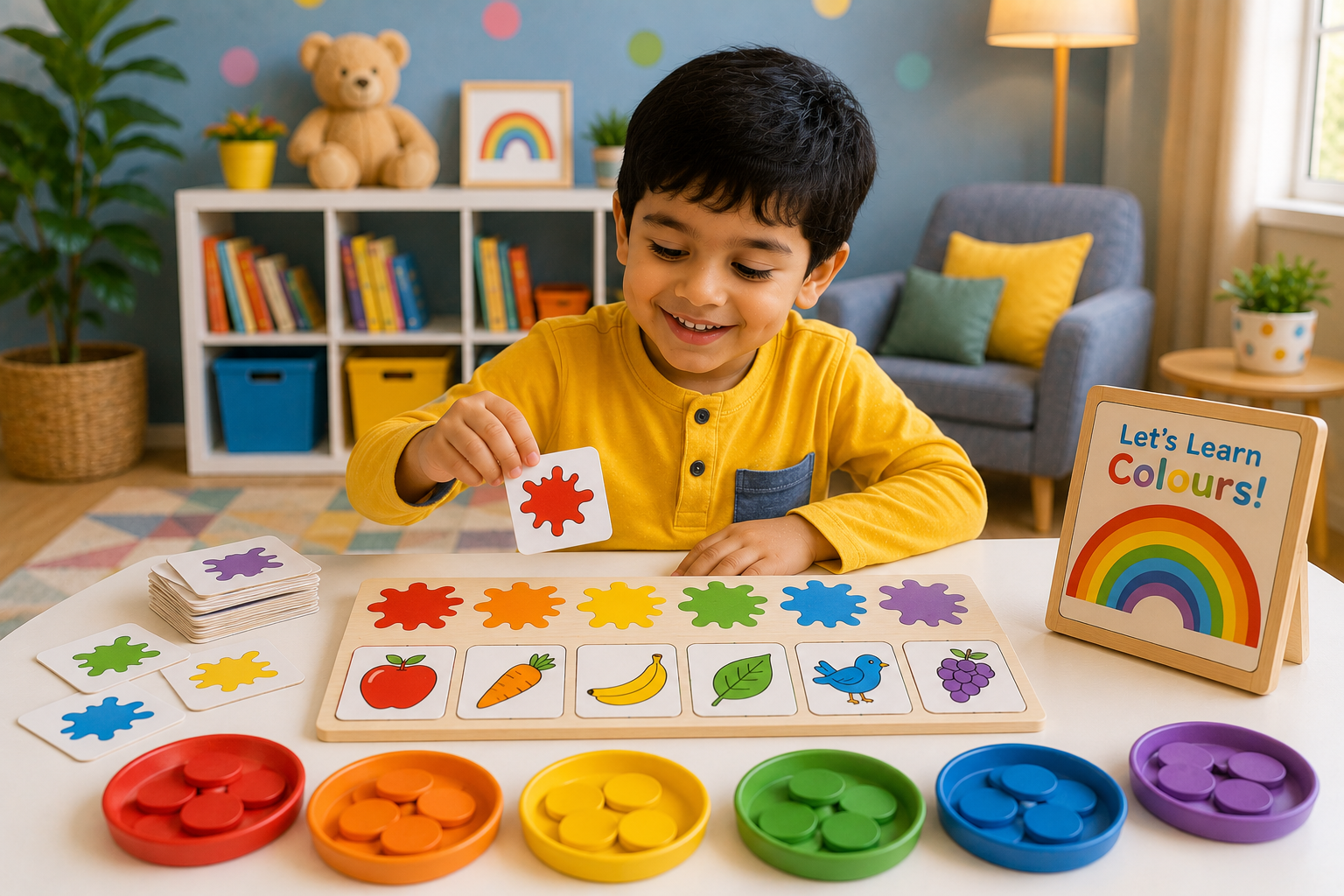
Colours are everywhere in a child’s world. The red cup at breakfast, the yellow toy on the floor, the green leaves outside, the blue shirt they choose to wear and the colourful pictures inside their favourite storybook all create natural opportunities to learn.
For young children, however, knowing that something has a colour and being able to confidently name that colour are two different things. A child may notice that two toys look different long before they can explain that one is red and the other is blue. This is where colour learning games for kids can make the process easier, more interactive and much more enjoyable.
Instead of repeatedly asking children to memorise colour names, parents can introduce matching activities, sorting challenges, treasure hunts, drawing games and interactive digital activities. Well-designed colour recognition games encourage children to observe, compare, identify and use colours in real situations. For families exploring preschool learning games UAE, colour activities can also become a simple part of home learning without making the experience feel like formal study.
Why Is Learning Colours Important for Young Children?
Colour recognition may seem like a simple preschool skill, but children use it in many different ways.
Learning colours can support their ability to:
- observe differences between objects;
- describe what they see;
- sort and classify items;
- follow instructions;
- expand everyday vocabulary;
- notice visual patterns;
- communicate choices;
- participate in creative activities.
Imagine asking:
“Can you bring me the red ball?”
The child needs to understand the object “ball” and the descriptive word “red.”
Or:
“Put all the blue blocks in this box.”
Now colour recognition becomes part of following instructions and sorting.
As children’s vocabulary develops, colour words also make their conversations more detailed.
Instead of saying:
“I want that car.”
they may eventually say:
“I want the blue car.”
That is a small but meaningful development in communication.
How Do Children Learn Colours?
Children usually learn colours through repeated exposure.
They hear adults naming colours.
They see them in books.
They use crayons.
They play with toys.
They notice colours in clothes, food, plants and familiar household objects.
Over time, the word and the visual appearance begin connecting.
A parent points at a banana and says:
“Yellow.”
Later, the child sees a yellow toy and begins understanding that the same word describes both objects.
This process is one reason playful repetition works so well.
The child does not need to sit down and memorise:
Red
Blue
Yellow
Green
Instead, they can encounter these colours repeatedly through normal life and colour learning games for kids.
Start With a Small Number of Colours
Parents do not need to introduce every possible colour at once.
Begin with a few common colours that children see frequently.
Good starting choices might include:
red;
blue;
yellow;
green.
Once these become familiar, gradually introduce colours such as:
orange;
purple;
pink;
brown;
black;
white.
Giving children too many unfamiliar colour names at once can make recognition more confusing.
It is usually better to help them confidently understand a smaller group before adding more.
Colour Matching Games
Matching is one of the easiest activities for young learners.
Place several coloured cards on a table.
Then give your child objects with matching colours.
For example:
red card → red block;
blue card → blue toy;
yellow card → yellow crayon.
Ask them to place each object beside the correct colour.
At first, you can name the colour together.
Later, ask:
“Where does the yellow block go?”
Matching encourages children to compare visual information.
Once they become comfortable, increase the challenge by using different objects in the same colour.
A red car and a red apple may look completely different, but they share one important feature: colour.
That helps children understand colour as a characteristic rather than something connected to only one object.
Turn Colour Practice Into a Treasure Hunt
You do not need expensive educational materials to create a good learning game.
Choose one colour and search around the house.
Say:
“Let’s find five blue things.”
Your child might discover:
a blue cup;
a blue book;
a blue sock;
a blue toy;
a blue cushion.
Then choose another colour.
This makes colour practice feel like exploration rather than testing.
You can also take the game outside.
Look for:
green leaves;
yellow flowers;
white cars;
brown tree trunks;
blue signs.
Everyday surroundings become learning materials.
If your child enjoys this kind of visual discovery, adding a short colour-based activity from EduPlayCraft can provide another playful way to reinforce the same skill before continuing the colour hunt around the house.
Colour Sorting Games
Sorting is another useful way to practise recognition.
Give children a mixed collection of colourful objects.
Ask them to organise the items into groups.
All red objects together.
All blue objects together.
All yellow objects together.
Building blocks work particularly well, but you can also use:
buttons;
toy cars;
craft pieces;
plastic cups;
paper shapes;
crayons.
Sorting encourages children to notice similarities and differences.
It also introduces early classification skills that will later become useful in maths and problem-solving.
Use Toys Children Already Love
Learning becomes easier when it involves something a child already enjoys.
If they love cars, sort toy cars by colour.
If they enjoy building blocks, build towers in different colours.
If they love dolls, talk about the colours of their clothes.
If they enjoy animals, use colourful animal pictures.
There is no need to separate educational play from ordinary play.
Simply add questions such as:
“Which car is red?”
“Can you find the green block?”
“What colour is the doll’s dress?”
These small conversations provide natural repetition.
Colour Recognition Through Drawing
Crayons and pencils offer one of the easiest ways to explore colours.
Ask your child:
“Can you draw a red circle?”
Then:
“Can you make a blue square?”
Or give them a simple picture and ask them to choose colours themselves.
While they draw, talk casually.
“What colour did you choose for the sun?”
“What colour are the leaves?”
“Do you want the house to be red or yellow?”
Creative activities allow children to use colour vocabulary without feeling as though someone is testing them.
Colour Bingo
Create a simple bingo sheet using coloured squares.
You might include:
red;
blue;
green;
yellow;
orange;
purple.
Call out:
“Green!”
The child finds the green square and covers it.
You can use small paper pieces, buttons or blocks as markers.
Later, make the game slightly harder by saying:
“Find the colour of grass.”
The child needs to think:
Green.
Now colour recognition becomes connected with general knowledge and vocabulary.
Match Colours With Familiar Objects
Some objects have colours children strongly associate with them.
Examples might include:
banana → yellow;
grass → green;
snow → white;
orange → orange.
Ask children to match coloured cards with appropriate pictures.
However, parents should also explain that real objects can appear in different colours.
Apples are not always red.
Cars are not always black.
Flowers come in many colours.
This helps children avoid assuming that each object belongs to only one specific colour.
Play “I Spy” With Colours
“I Spy” is ideal for colour learning.
Say:
“I spy something red.”
Your child looks around and guesses.
“Is it the cushion?”
“Is it the toy car?”
Then switch roles.
Let your child choose a colour and give you the clue.
This encourages both recognition and spoken vocabulary.
It also requires no preparation.
You can play while waiting somewhere, travelling, sitting at home or walking outdoors.
Colour Memory Games
Memory games can combine colour recognition with concentration.
Create pairs of coloured cards.
For example:
two red cards;
two blue cards;
two green cards;
two yellow cards.
Place them face down.
Children turn over two cards at a time.
If the colours match, they keep the pair.
If not, the cards are turned back over.
To succeed, children need to remember where each colour appeared.
This turns simple colour recognition games into activities that also involve memory and attention.
Use Clothes for Colour Learning
Getting dressed provides a natural learning opportunity.
Ask:
“Do you want the blue shirt or the green shirt?”
“What colour are your socks?”
“Can you find your black shoes?”
Letting children make simple choices gives them a reason to use colour words.
Laundry can become a sorting activity too.
“Can you find the two white socks?”
“Put the blue clothes together.”
Learning does not need to happen only during dedicated educational time.
Make Snack Time Colourful
Food provides another opportunity to practise colour words.
You might have:
red strawberries;
green grapes;
orange carrots;
yellow bananas.
Ask:
“What colour is your banana?”
“Can you find something red?”
“Which fruit is green?”
Food colours are not always perfectly consistent, of course, but the conversation can still build vocabulary.
You can even create a simple challenge:
“Can we find three different colours on your plate?”
Now snack time becomes a short observation game.
Can Online Colour Games Help?
Digital learning can add variety to colour practice.
Well-designed colour learning games for kids may ask children to:
identify a requested colour;
match objects of the same colour;
sort colourful items;
choose a colour based on a spoken instruction;
complete a pattern;
find an object that matches a colour.
The child has to make a decision rather than simply watch an animation.
That interaction matters.
When looking at preschool learning games in the UAE, parents can choose activities that have a clear objective and are simple enough for children to understand independently or with minimal support.
Digital games work best when they are one part of a broader learning routine rather than the entire routine.
Take the Digital Lesson Into the Real World
Suppose your child has just completed an online game involving red, yellow and blue.
Do not stop when the screen turns off.
Ask:
“Can you find something red?”
“Where is something yellow?”
“Can you bring me a blue toy?”
The digital activity introduces or reinforces the concept.
Real objects help children understand that colours exist everywhere.
This combination can make online learning much more meaningful.
If you want to try this approach, choose one suitable EduPlayCraft colour activity, let your child complete a short session and then challenge them to find examples of those colours around the home.
Introduce Light and Dark Colours Gradually
Once children confidently recognise basic colours, you can introduce variations.
For example:
light blue;
dark blue;
light green;
dark green.
Place two blue objects side by side.
Ask:
“Are these exactly the same blue?”
Children begin noticing that a single colour can appear in different shades.
Do not worry about introducing complicated colour terminology too early.
The goal is simply helping children become more observant.
Colour Mixing Can Feel Like Magic
One of the most exciting ways to learn about colours is mixing them.
With washable paint, demonstrate simple combinations.
Red + yellow = orange.
Blue + yellow = green.
Red + blue = purple.
Before mixing, ask:
“What do you think will happen?”
Let children make predictions.
Then observe the result together.
This turns colour learning into a small experiment.
It also introduces cause and effect.
Children see that colours can change when combined.
Use Water and Food Colouring for Simple Experiments
With appropriate adult supervision, coloured water can create another interesting activity.
Place water in clear containers and add safe colouring.
Ask children to identify each colour.
You can then mix small amounts and observe what happens.
The visual transformation often captures children’s attention.
The activity feels more like discovery than memorisation, which is exactly what makes playful learning powerful.
Create Colour Patterns
Once basic recognition is comfortable, colours can introduce pattern skills.
Arrange blocks:
red, blue, red, blue…
Ask:
“What colour comes next?”
Then try:
yellow, green, green, yellow, green, green…
Patterns require children to recognise colours while also noticing repetition.
This combines colour knowledge with early logical thinking.
Digital colour recognition games can also use repeating sequences to make colour activities more challenging for children who already know the basic names.
Play Traffic Light Colours
Red, yellow and green can become a movement game.
Use simple instructions:
Green = move.
Yellow = walk slowly.
Red = stop.
Children need to listen, recognise the colour and change their movement accordingly.
This adds physical activity to the learning experience.
It can also be played outside where children have more room to move.
For young children who find sitting activities difficult, movement-based games can make learning far more enjoyable.
Use Storybooks to Find Colours
Books are full of colourful illustrations.
While reading, occasionally ask:
“What colour is the car?”
“Can you find something green?”
“What colour is the character wearing?”
Do not stop on every page.
Story time should still feel enjoyable.
One or two casual questions are enough.
Over time, children may begin pointing out colours themselves.
That spontaneous use of colour vocabulary is often a sign that recognition is becoming more confident.
Let Children Choose Colours
Choice encourages children to use colour words meaningfully.
Instead of handing them any cup, ask:
“Would you like the red cup or the blue cup?”
Instead of selecting their crayon:
“Which colour do you want?”
The child has a practical reason to understand and communicate a colour.
This can be particularly helpful when a child knows colours but does not often say their names independently.
Don’t Turn Every Activity Into a Quiz
There is a difference between practising and constantly testing.
If parents repeatedly ask:
“What colour is this?”
“What colour is that?”
“And this?”
children may eventually become tired of answering.
Mix direct questions with natural conversation.
Say:
“I like your green block tower.”
Or:
“You chose a bright yellow crayon.”
Children hear colour vocabulary even when they are not required to respond.
That exposure matters too.
It’s Fine If Children Confuse Colours
Young children may occasionally mix up colours.
One day they confidently identify blue.
The next day they call it green.
That does not mean the learning has disappeared.
Recognition is developing.
Rather than making the mistake feel serious, simply respond naturally.
“That one is blue. Can you find another blue object?”
Give children repeated opportunities to see the correct word connected with the colour.
Patience is more useful than pressure.
How Often Should Parents Practise Colours?
There is no need to schedule long daily colour lessons.
Short moments throughout the day can be enough.
Five minutes sorting blocks.
A quick colour hunt.
Talking about clothes.
Choosing crayons.
Playing an online game.
Looking at pictures in a storybook.
Because colours appear everywhere, practice can happen naturally without creating extra work for parents.
Create a Simple Weekly Colour Routine
If you prefer a little structure, try something like:
Monday: Colour matching
Tuesday: Colour treasure hunt
Wednesday: Drawing and colouring
Thursday: Colour sorting
Friday: Online colour game
Weekend: Outdoor colour spotting or simple colour mixing
Each activity can take only a short amount of time.
You can repeat favourites as often as your child enjoys them.
Follow Your Child’s Interests
A child fascinated by vehicles may enjoy finding differently coloured cars.
A child who loves animals may prefer colourful animal pictures.
A child who enjoys crafts may want to paint.
A child interested in building may prefer sorting blocks.
The learning goal stays the same.
Changing the theme simply makes the activity more personally interesting.
Good preschool learning games UAE should work with children’s curiosity rather than forcing every child to learn in exactly the same way.
Add Vocabulary to Colour Activities
Once children confidently recognise basic colours, begin combining them with other words.
Instead of:
“Red.”
Try:
“Red apple.”
“Big red ball.”
“Small blue car.”
“Green leaf.”
This introduces descriptive language.
Later, ask children to describe objects themselves.
“What do you see?”
They might say:
“A blue car.”
Now colour recognition is supporting communication as well as visual learning.
Sort by More Than One Feature
Older preschoolers can take sorting further.
Give children blocks with different colours and shapes.
Ask:
“Can you find all the red circles?”
Now they need to consider two characteristics:
red;
circle.
Or:
“Find the blue squares.”
This requires more careful observation than sorting by colour alone.
It can become a simple problem-solving activity.
Turn Cleanup Into Colour Sorting
Tidying toys can become another quick game.
“Let’s put all the red blocks away first.”
“Now find the yellow ones.”
“Can you collect the blue cars?”
Your child practises colours and you get help cleaning the room.
That is a useful combination.
More importantly, it shows that learning concepts can be applied during normal routines.
Use Nature for Colour Learning
Outdoor environments offer countless colours.
Ask children to look for:
green leaves;
brown branches;
blue sky;
colourful flowers;
grey stones.
You can create a simple colour checklist before going outside.
Try to find one natural object for each colour.
Do not pick plants or objects where that is inappropriate; simply observe them.
The activity develops attention as well as colour recognition.
Digital and Hands-On Colour Learning Can Work Together
Parents sometimes feel they must choose between digital learning and traditional play.
There is no need.
The two can complement each other.
A child might play an interactive colour game, then sort physical toys according to the colours they practised.
They might identify purple online, then find a purple crayon and draw something.
They might complete a digital pattern and then recreate it using blocks.
That transition between formats helps children see that the skill is not limited to one activity.
For families using EduPlayCraft at home, pairing a digital colour game with drawing, sorting, reading or a real-world colour hunt can keep learning varied and practical.
What Makes a Good Colour Learning Game?
A useful game should have a clear purpose.
Ask:
Does the child actually need to recognise colours?
Are instructions simple?
Is the activity appropriate for the child’s ability?
Does the child have to make a choice?
Can mistakes be corrected without creating frustration?
Is the activity engaging without being overly distracting?
A colourful game is not automatically a good colour-learning game.
The important part is what the child is doing with the colours.
Keep Learning Playful
Children do not need to master every colour as quickly as possible.
The aim is helping them notice, understand and eventually use colour words confidently.
That happens through repetition.
But repetition does not have to mean repeating the exact same activity.
Red can appear in:
a game;
a crayon;
an apple;
a shirt;
a toy car;
a storybook;
a flower.
Each new context strengthens understanding.
That is why colour learning games for kids work particularly well when parents connect them with everyday experiences.
Making Colour Learning Part of Everyday Life
Teaching colours does not require a special classroom at home.
The learning opportunities are already around you.
Ask about the colour of a favourite toy.
Sort laundry.
Choose clothes.
Draw pictures.
Look at fruit.
Walk outdoors.
Build block patterns.
Play colour recognition games.
Use a short digital activity and then search for the same colours around the room.
The most useful learning often happens through these ordinary moments.
For parents exploring preschool learning games UAE, the goal should not simply be keeping children busy on a screen. It should be giving them opportunities to observe, think, communicate and then connect what they learn with the world around them.
When children begin recognising colours confidently, something interesting happens.
They do not just see a flower anymore.
They see a yellow flower.
They do not simply want a toy.
They want the red one.
Their descriptions become richer, their observations become more detailed and their ability to compare the world around them continues to grow.
And all of that can begin with something as simple as asking:
“Can you find something blue?”
FAQs
1. How do colour learning games help young children?
Colour learning games for kids give children repeated opportunities to identify, compare, match and use colours in different situations. They can also support observation, sorting, vocabulary, following instructions and visual discrimination. Interactive activities make repetition feel more playful while helping children connect colour names with what they see.
2. At what age do children usually start recognising colours?
Children often begin noticing differences between colours before they can confidently name them. Colour recognition and naming generally develop gradually during the toddler and preschool years, but every child progresses differently. Parents can introduce simple colours naturally through toys, books, clothing, food and everyday conversations without putting pressure on children to master them by a particular date.
3. What are fun ways to teach colours at home?
Parents can use colour recognition games, treasure hunts, sorting activities, crayons, building blocks, colour bingo, storybooks, clothing, food, play dough and simple colour-mixing experiments. Everyday questions such as “Can you find something green?” or “Would you like the red cup or blue cup?” can also make colour learning part of normal family routines.
4. Can online games improve colour recognition skills?
Interactive online activities can provide useful colour-recognition practice when they require children to identify, match, sort or select colours. Preschool learning games UAE can be especially useful as one part of a balanced routine, but digital practice works best when parents also give children opportunities to recognise and use the same colours with physical objects and real-world activities.
5. How can parents combine digital colour games with everyday activities?
After a digital colour game, parents can ask children to find matching colours around the home, sort toys, choose corresponding crayons, identify colours in books or look for them outdoors. For example, after practising red, blue and yellow online, ask the child to find one real object in each colour. Combining colour learning games for kids with everyday exploration helps children understand that the colours they see on screen are part of the world around them too.